The manure simply dries on the belt. It is a very clean way of working, and you see that throughout the whole house.
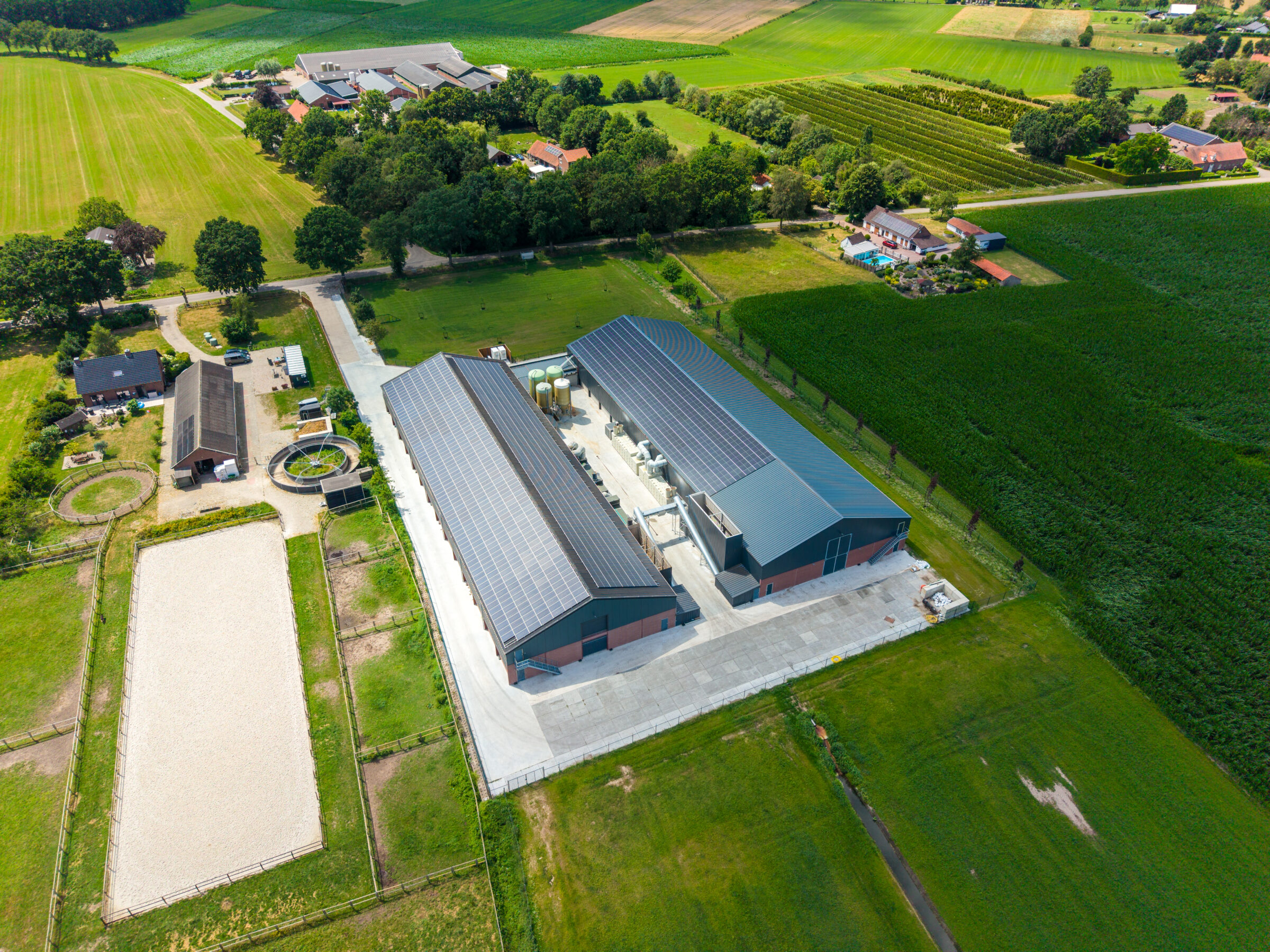
In Ospel, in the Dutch province of Limburg, poultry farmer Rob Adams built a completely new layer house that meets the emission requirements from day one. The finishing touch: two Scan-Air OptiFlow heat exchangers, which dry the manure on the manure belts in a clean and controlled way, reducing particulate matter and ammonia.

The farmer
We visited the farm in Ospel on a sunny day. The yard was neat, clean and well organised, matching the way work is done here. We spoke with poultry farmer Rob Adams and farm manager Thijs Briels, a driven manager with a clear passion for his work and his animals.
Rob Adams took over the farm at this location in 2025. Adams Pluimvee operates several laying hen locations. The existing house was completely renovated: the outer walls were kept, everything else was rebuilt from scratch. In addition, a completely new house was built on the site of the old houses. Both houses have two tiers. The renovated house holds 48,000 hens, the new build 58,000. That scale and the two-tier layout define the farm. The eggs are sold on the German market.
The challenge
The permit for the new house was already in place, and it focused on two things: reducing particulate matter in combination with increased exhaust capacity, and drying the manure to achieve a higher dry matter content at removal. A heat exchanger was therefore not optional, but a requirement. Because the manure dries faster, less ammonia is released as well: clean manure drying and lower emissions go hand in hand. The question was not only which heat exchanger to choose, but how it would fit into a house that has to function as a whole.
The solution: two OptiFlow heat exchangers
The new house has two tiers. An OptiFlow heat exchanger was installed for each tier, two units in total.

The principle is simple. The heat exchanger recovers heat from the exhaust air and transfers it to the incoming fresh air. The supply air enters preheated, so less energy is needed to keep the house at the right temperature. In this layer house, the preheated air is led to the manure belts via the main distributor and the aeration ducts. As a result, the manure dries faster, and that is exactly where the gain lies: drier manure means significantly less ammonia, and fewer dust and moisture particles in the indoor air, so lower particulate emissions as well.
Manure belt aeration with manure drying is a recognised emission-reducing technique for layer houses in the Netherlands. This means the OptiFlow not only helps get the manure dry for removal, it also demonstrably contributes to meeting environmental legislation. At the same time, the climate in the house improves: the air stays drier and the concentration of harmful gases decreases.
Technically, the OptiFlow achieves this with horizontally placed hollow PVC plates, 8 metres long, and a thermal efficiency of over 80%. The air is distributed evenly through the house via the main distributor and the aeration ducts, and the units are easy to keep clean thanks to large, accessible hatches with rubber seals and an automatic flushing system. The heat exchangers do not run as a separate system, but are integrated into the central climate control. This allows the farm management to control everything from one system: ventilation, temperature, lighting and daylight, and alarms, including the heat exchangers.
Matched components for one climate system
The air inlets and windows in the house come from Tulderhof, part of Scan-Air. When the permit required a heat exchanger, the OptiFlow was the logical addition. Air inlets, windows and heat recovery now form one coherent climate system: components from the same group, designed to work together rather than assembled from different brands. The OptiFlow is the finishing touch.

In practice
The new house has only been in operation for a short time, but the first experiences are positive.
You notice straight away that the climate is right. It is pleasant to work in and the house stays clean, and in the end that is what you do it for.
What stands out is the calm and order: a clean, controlled way of working that matches the technology behind it. As the house is used for longer, it will become clear how manure drying translates into daily practice over a full year.
Ready for tomorrow’s emission requirements
With the OptiFlow heat exchangers and the matched air inlets and windows from within the group, Scan-Air provides the building blocks for a complete climate system. Manure belt aeration with manure drying is a recognised emission-reducing technique, allowing the new house to meet its permit requirements while benefiting from drier manure, less ammonia and particulate matter, and a better indoor climate. For a poultry farmer who wants to move forward and operates multiple locations, matched components are a choice that pays off in the long run.